
St. Mary Parish County Court Records After Jail Arrest
Court records after a jail arrest in St. Mary Parish County are built through the 16th Judicial District system and the St. Mary Parish Clerk of Court. The arrest starts the custody process. Booking creates the jail record. The 16th Judicial District Attorney then decides what formal charge, if any, should be filed in court. That distinction is central. A roster charge may be a preliminary arrest charge, while the court record may later show an amended charge, a reduced charge, a dismissal, a nolle prosequi, or a conviction.
Use jail inmate records for custody, booking date, booking number, bond shown on the roster, and current or recent release status. Use jail roster mugshots when the question is whether a booking photo appears on the sheriff or city roster. Use the court and clerk channels for filed charges, case status, hearing activity, dispositions, and official record copies. The same arrest can appear differently across those systems because each office records a different part of the case.
Find St. Mary Parish County Court Records After Arrest
The main online court-record channel located in the research is St. Mary Parish Clerk eSearch. It is not a free open roster. The inspected page sends public records search users to login, account creation, and subscription choices. The eSearch inventory says the available indexes include Criminal, and it also references verdict civil and verdict criminal index and docket history with no images available. The Clerk's disclaimer says online records are not official; records in the Clerk's office are the official public records.
- Start with the sheriff or city roster to collect the person's full name, booking date, booking number, and listed charges.
- Open St. Mary Parish Clerk eSearch or contact the Clerk's office when official criminal index or docket information is needed.
- Search the criminal index or docket history by the available name or case data once access is available.
- Compare the court charge list with the jail roster charge list and note any amendment, reduction, dismissal, or pending status.
- Use the 16th Judicial District Court or 16th Judicial District Attorney channels for court location and prosecutorial routing, not for legal advice.
The Clerk eSearch screenshot shows the login, subscription, criminal index notice, and official-record disclaimer that shape online access.
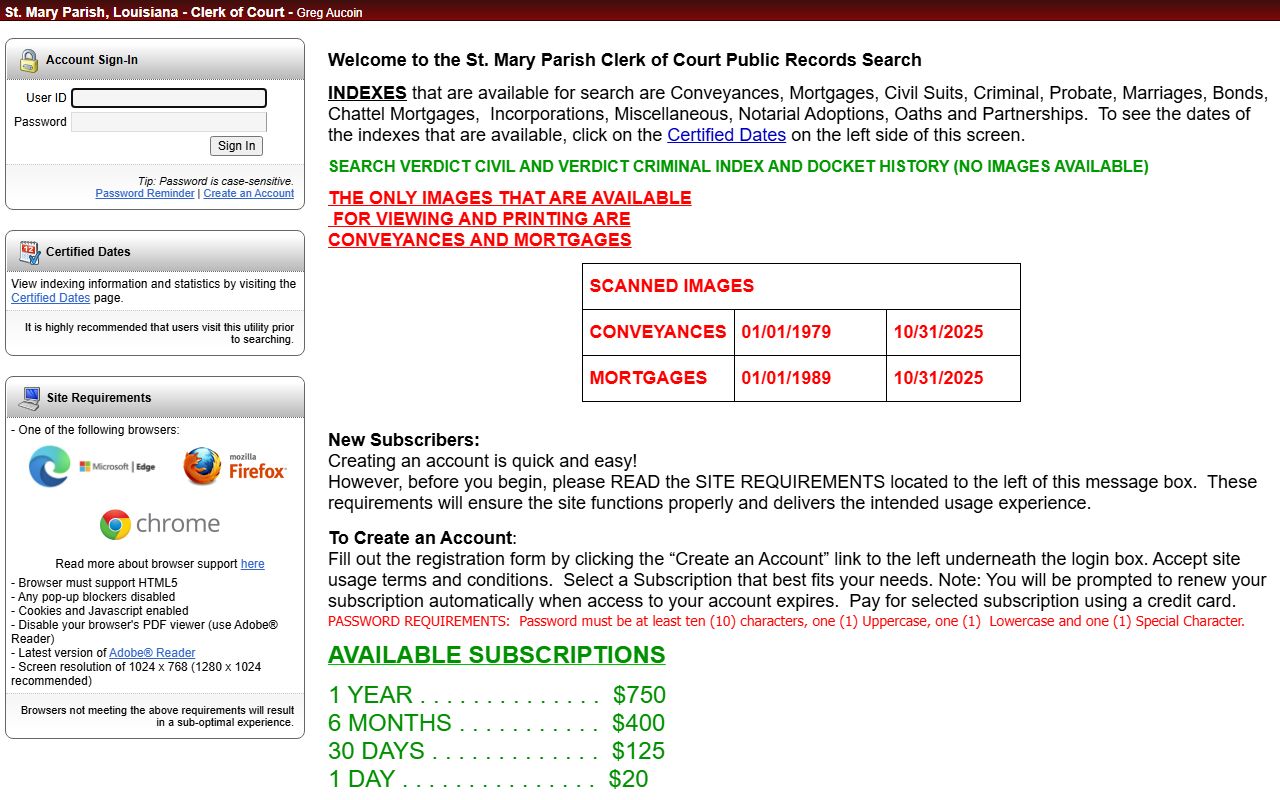
Because the online system contains released records that have been recorded, indexed, verified, and released for public viewing, a new arrest may not appear there right away.
St. Mary Parish County eSearch Fees
St. Mary Parish Clerk eSearch is subscription-based in the captured research. That is a major difference from the free sheriff jail roster. The roster is for custody and booking facts. The paid Clerk system is for court-index and docket-history work when the case has reached the court record. Use the fee schedule only as a portal access summary, and verify current prices with the Clerk before purchasing access.
| Item | Amount or Scope | Notes |
|---|---|---|
| 1-year subscription | $750 | Online indexed access option shown in eSearch |
| 6-month subscription | $400 | Online indexed access option shown in eSearch |
| 30-day subscription | $125 | Online indexed access option shown in eSearch |
| 1-day subscription | $20 | Short access option shown in eSearch |
| Printing | $2 per page | Printing fee from eSearch inspection |
| Credit card surcharge | $0.49 plus 3.49% | Applies to credit card transactions |
Charging Documents After a St. Mary Parish County Arrest
After a St. Mary Parish County arrest, the formal court case is driven by the charging decision, not just the jail entry. The district attorney may file charges by bill of information, proceed through a grand jury indictment when the case calls for it, amend a charge, reject a charge, or dismiss a count. The research did not locate a local court page that labels every document type for each case, so the table below explains the common criminal charging paths in plain language.
| Document | Who Uses It | What It Does |
|---|---|---|
| Complaint | Law enforcement or prosecutor | States the alleged offense or facts that start a criminal accusation. |
| Bill of information | District attorney | Formal prosecutor-filed charging document used in many Louisiana criminal cases. |
| Indictment | Grand jury | Formal charge returned by a grand jury, often for more serious felony matters. |
For St. Mary Parish County court records after arrest, the practical point is simple: do not stop at the jail roster charge. Check whether the prosecutor filed the same count, changed it, added a count, or declined it.
District Attorney Charging Role
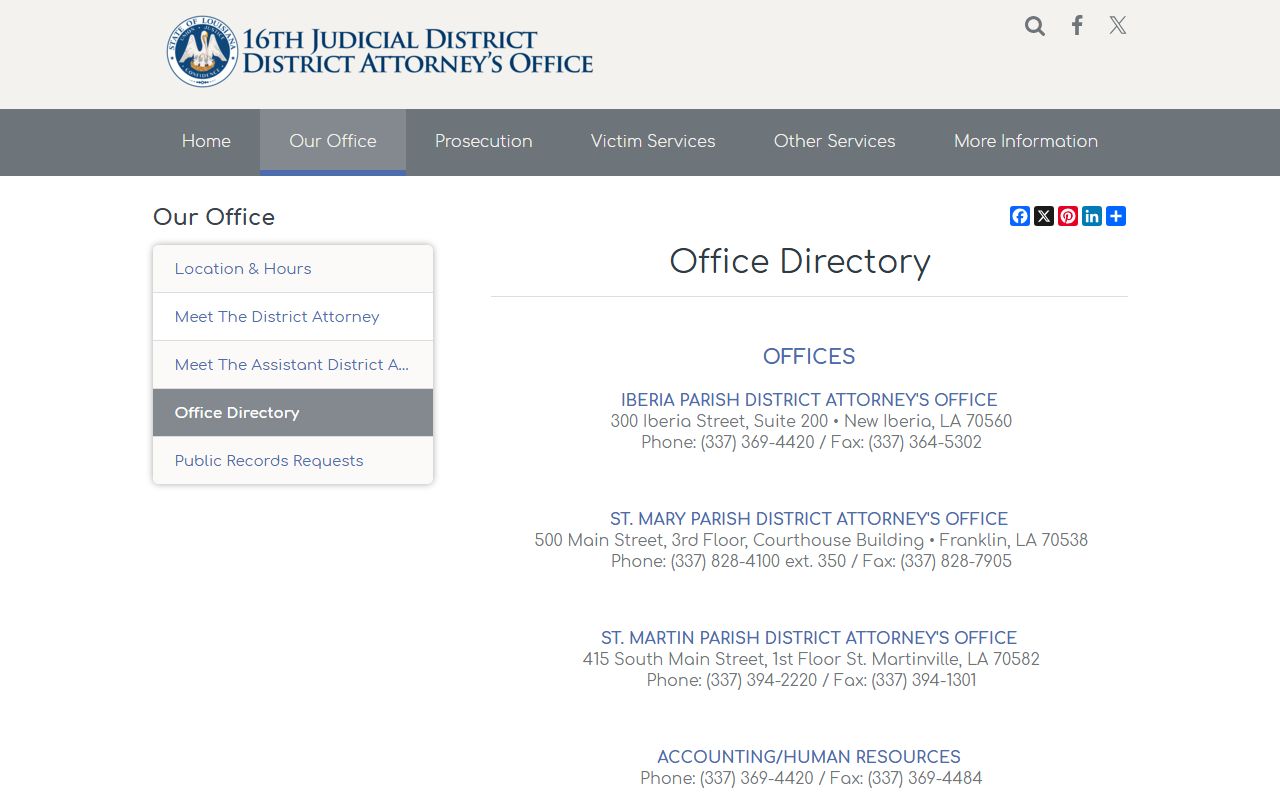
St. Mary Parish is served by the 16th Judicial District Attorney, covering Iberia, St. Martin, and St. Mary parishes. The DPS&C St. Mary location page listed M. Bofill (Bo) Duhé as the current district attorney. The St. Mary Parish DA office is listed at 500 Main Street, 3rd Floor, Courthouse Building, Franklin, LA 70538, with phone 337-828-4100 ext. 350 and fax 337-828-7905. Office hours posted by the DA site are 8:30 a.m. to 4:30 p.m., Monday through Friday.
The 16th JDA office directory provides the local St. Mary Parish office details used for court-record routing.
The DA office can route prosecutorial questions, but it is not a substitute for a lawyer, the Clerk's official record, or court orders in the case file.
St. Mary Parish County Charge Status
Charge status tells where a count stands after the arrest moves into court. A pending charge is unresolved. An amended charge has changed. A reduced charge is a less serious or different count. A dismissal or nolle prosequi means prosecution ended on that count. A conviction requires a guilty plea, accepted plea, verdict, or adjudication. An arrest alone is not a conviction.
| Status | What It Means |
|---|---|
| Pending | The count has not been resolved by plea, verdict, dismissal, or other final action. |
| Amended | The prosecutor or court changed the charge from the original wording or level. |
| Reduced | The charge was lowered to a lesser charge or less serious level. |
| Dismissed | The court record shows the count ended without conviction on that count. |
| Nolle prosequi | The prosecutor declined to continue prosecution on that count. |
Bond Review After Arrest
The St. Mary Parish roster publishes bond amounts on list entries, but it does not label the bond type in the list view. The research found examples ranging from $0.00 to six-figure totals. A $0.00 bond entry should not be read by itself. It may reflect no bond, a hold, sentence service, a satisfied bond, a court status, or another reason. Always confirm the bond amount, bond type, payment location, and accepted payment method with the jail information system at 337-836-9509 or with the issuing court before paying.
| Bond Type | How It Works |
|---|---|
| Cash bond | Money is posted directly under court or jail rules for release conditions. |
| Surety bond | A licensed bail agent posts surety; family usually pays a premium or fee. |
| Personal recognizance | The person is released on a promise to return to court without upfront bond money. |
| No-bond or hold | Payment may not release the person because another order, agency, detainer, or sentence controls custody. |
Louisiana CCP art. 230.1 requires a person in custody to be brought before a judge within 72 hours from arrest, excluding weekends and legal holidays, for appointment of counsel. The court may determine or review bail at that appearance.
Warrants and Court Records After Arrest
The sheriff FAQ is the best local warrant source in the research. It says a warrant is issued and signed by a magistrate or judge and authorizes an arrest, search, or other justice-related act. The FAQ gives the Warrants Division phone numbers as 337-907-0407 and 337-907-0408. A caller will be asked questions, and an investigator will search sheriff records. To clear an arrest warrant, the person must return to the court that issued it, and a judge or magistrate decides what happens next.
The sheriff also publishes a Most Wanted page behind an official disclaimer and accept screen. Treat it as a posted wanted-subject channel, not a complete warrant database. For bench warrants tied to court cases, use Clerk eSearch or the issuing court. Morgan City has a warrants page in its navigation, and its roster examples include warrant-related charges, so city-court or municipal matters may need city-court routing.
Charges vs Convictions
A St. Mary Parish County arrest record, jail roster entry, or court charge is not proof of conviction. A charge is an accusation or formal count. A conviction follows a plea, verdict, or court judgment. This distinction matters for employers, landlords, licensing, family questions, and personal record checks. It also matters because the same case can have pending, amended, dismissed, and convicted counts at the same time.
| Charge | Conviction | |
|---|---|---|
| Meaning | An accusation listed by law enforcement or filed by a prosecutor. | A court result after a plea, verdict, or accepted adjudication. |
| Timing | Appears after arrest, booking, or formal filing. | Appears only after the court resolves guilt on that count. |
| Can change? | Yes. It may be amended, reduced, or dismissed. | Yes, but only through later court action, appeal, post-conviction relief, or other legal process. |
Restricted Court Records After Arrest
Some St. Mary Parish County court records after arrest may be restricted by law, court order, juvenile rules, expungement, sealing, or an ongoing investigation exception. The research did not locate a full local expungement guide, so the page should not promise eligibility. It can state the practical record rule: a dismissal, acquittal, non-prosecution, expungement, vacated conviction, or pardon may affect access and may support booking-photo removal from certain remove-for-pay publications under Louisiana CCP art. 234.
| Sealed | Expunged | |
|---|---|---|
| Public access | Hidden or limited by court order or law. | Limited under the expungement order and Louisiana law. |
| Official access | Some agencies or courts may retain access. | Some law-enforcement or court access may remain depending on the order. |
| Eligibility | Depends on case type, outcome, and court order. | Depends on Louisiana expungement law and the court's ruling. |
Public Access to St. Mary Parish County Court Records
Louisiana R.S. 44:1 defines public records and custodians. Louisiana R.S. 44:31 gives adults the right to inspect, copy, or reproduce public records unless a specific exception applies. For booking facts, Louisiana CCP art. 228 says booking books and booking information summaries are open for public inspection. Court files, however, must still be checked through the Clerk and court system because the jail roster is not the official case record.
Important: This private reference site is not a consumer reporting agency, and court or jail information must not be used for FCRA-covered decisions.